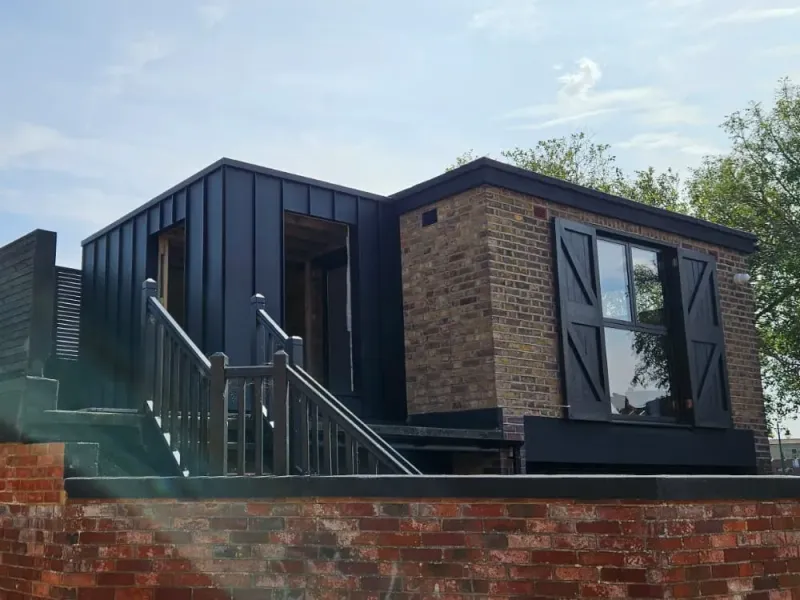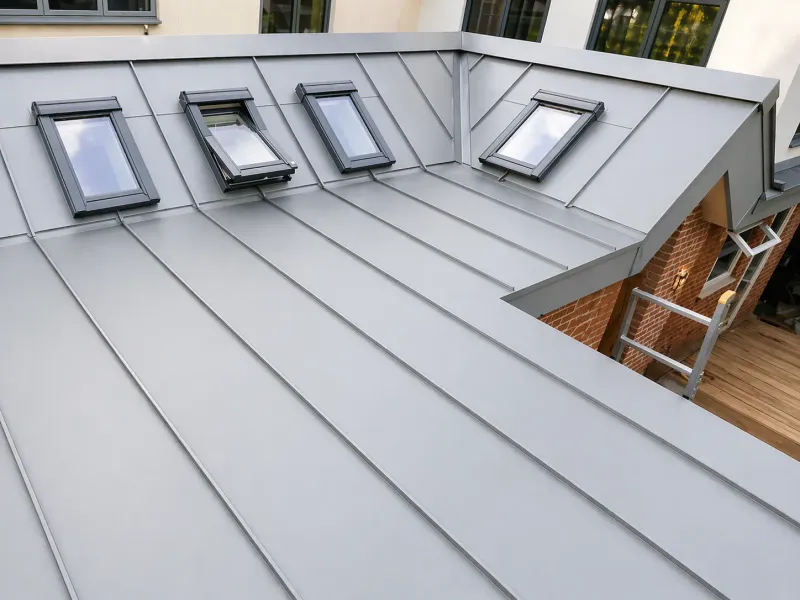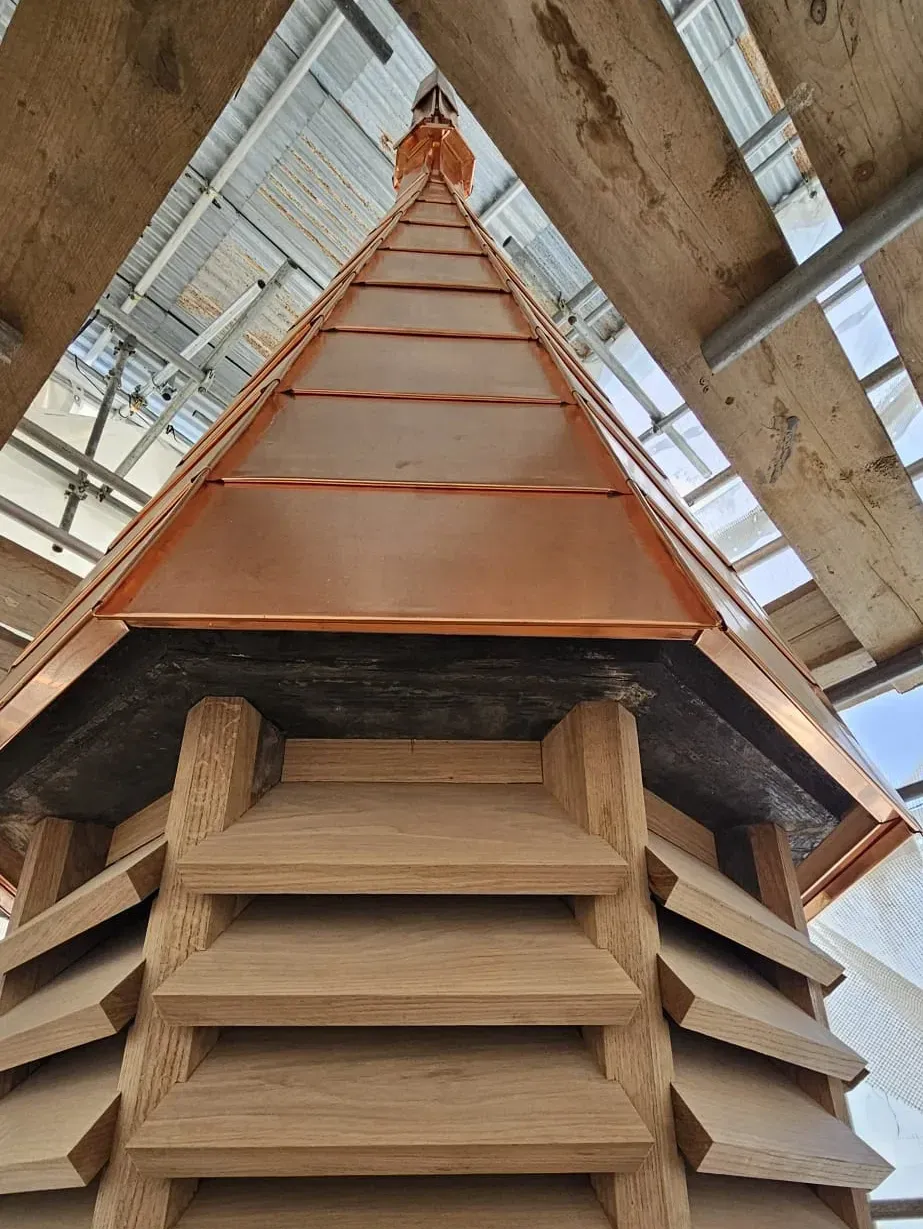
Both copper roofing and zinc roofing last a century, both develop a protective patina, and both need a specialist to install them well. The question isn’t which material is better. It’s which one fits your project. For most residential extensions and loft conversions in London and the South East, zinc is the stronger choice on cost and versatility. Copper earns its premium on heritage work, bay windows, and projects where the material is part of the design statement.
Key takeaways
- Zinc costs around £160–£180/m² installed; copper around £250–£280/m², roughly 50–60% more
- Copper lasts 100+ years; zinc 80-100 years. Both are lifetime roofing materials
- For extensions and loft conversions, zinc is the default; copper is the right call on heritage and prestige work
- Copper cannot drain onto zinc. Mixing the two metals on one project requires careful design
How do copper and zinc compare on cost?
Installed zinc roofing in the UK typically starts from around £160–£180/m² for a straightforward roof plane, while copper typically starts from around £250–£280/m², roughly 50–60% more. Copper’s higher cost comes down to raw material: copper sheet costs significantly more than zinc per kilogram, even though it’s a thicker gauge that covers the same area with fewer, more precise pieces.
On a 20m² bay window, that cost difference is around £1,900. On a 60m² extension roof, it’s closer to £5,700. That’s a meaningful sum, but for the right project, copper’s additional cost is easy to justify. For a straightforward rear extension roof, it’s harder to make the numbers work. Both materials are most commonly installed as standing seam systems.
What do they look like, and how do they age?
The visual difference between copper and zinc isn’t just about colour. It’s about how dramatically the material changes over time. Zinc moves from a bright silver-grey to a soft, matte blue-grey within roughly three years on an exposed roof, and over 10 years on a protected soffit (VMZINC UK). Copper, by contrast, starts as warm orange-brown and passes through dark brown before reaching the verdigris green that most people picture. The journey to full patination takes 7-9 years in marine environments, 15-25 years in industrial ones, and 10-30 years in rural locations (Wikipedia, Copper in Architecture).
That transition period matters for homeowners. A copper roof on a London terraced house will sit at dark-brown for several years before it greens. If you picture verdigris and expect it at year two, you’ll be disappointed. Zinc’s shift is subtler and faster; most clients find the matte grey it settles into within a few years is the finish they wanted all along.
For copper, the corrosion rate in rural atmospheres is less than 0.4mm over 200 years (Wikipedia, Copper in Architecture). That’s not a typo. The patina protects what’s underneath almost indefinitely.
Which projects suit copper, and which suit zinc?
Zinc is the stronger choice for:
- Rear extensions and flat roofs: cost, contemporary look, handles low pitches cleanly
- Loft conversions and dormers: versatile, lightweight, works across a wide pitch range
- Contemporary new builds: the matte grey finish sits well alongside brick, timber, and render
- Commercial re-roofing: cost and scale make zinc (or steel) the practical choice
Copper is the stronger choice for:
- Heritage and listed buildings: centuries of precedent, well accepted by conservation officers, longevity matches the building’s expected life
- Prestige and architectural feature elements: entrances, canopies, cupolas, and roofs where the material is intended to make a statement
- Front bay windows on period properties: the verdigris finish develops character that zinc doesn’t replicate
Either works on:
- Bay window roofs generally: both are commonly specified; the decision comes down to budget and what finish the client wants at year 20
On listed buildings and in conservation areas, copper is frequently the material that planning officers are most comfortable with. It has centuries of precedent in UK architecture. Zinc is also accepted and used on heritage projects regularly, but copper is the more traditional specification. Where a conservation officer is involved, it’s worth knowing which way their preference runs before the material is fixed. For a broader look at how the metals compare across other properties, see our guide to choosing metal cladding.
Where copper genuinely wins
Copper’s lifespan is in a category of its own. Studies in metallurgy suggest copper alone (not the substrate it sits on) could theoretically last 1,000 years (Wikipedia, Copper in Architecture). In practice, copper roofs with 100+ years of service life are common across Europe. For heritage buildings, listed structures, and architectural feature elements, that permanence is part of the specification rationale.
Copper also wins on character. No other roofing material has the same visual evolution. The warmth at installation, the mid-life browns, the eventual verdigris: a copper-clad building looks different at year 5, year 20, and year 50, and at each stage it looks deliberate. On entrances, canopies, bay windows, and prominent feature roofs, that’s a genuine advantage. It’s the difference between a roof that blends in and one that becomes part of the building’s identity.
Cost is rarely the deciding factor when copper is the right call. Projects where the budget is tight rarely end up specified in copper, and that’s fine. The ones that do tend to be heritage restorations, high-specification new builds, and projects where the client has a clear idea of what they want the building to look like in 30 years.
Where zinc genuinely wins
Zinc is the workhorse of high-specification residential roofing in London. It’s more affordable than copper, widely understood by planning departments, compatible with a broad range of contemporary architectural materials, and well-suited to the low-pitched roofs that dominate London extension work.
The BRE Environmental Product Declaration puts zinc’s expected service life at 80-100 years. There are real-world examples that exceed this significantly: the zinc roof on Liverpool Central Library, installed in 1879, lasted 133 years before replacement (VMZINC UK). That’s not a headline statistic designed to sell the material. It’s a useful data point about what a properly installed zinc roof can do.
On residential extension work in London and the South East, zinc is the material we specify most often. It handles flat and low-pitched roofs cleanly, it looks right alongside brick and timber, and it doesn’t require clients to accept copper’s cost premium for their rear extension.
Zinc’s sustainability credentials are strong, too. Around 99% of zinc roofs in Western Europe are recycled at end of life (VMZINC UK). For self-build and new-build clients with sustainability targets, that’s a meaningful number.
The compatibility issue you can’t ignore
This is the detail that gets glossed over in most material comparisons, and it catches out homeowners and architects on mixed-material projects: copper cannot drain onto zinc, aluminium, or steel. Copper ions in runoff will corrode any of these metals on contact. On a straightforward roof where the entire covering is copper or the entire covering is zinc, there is no issue. On a project that uses both metals, or where copper drainage runs past a zinc or aluminium fascia, the design has to account for this.
The practical implications: on a building where you’re adding a copper bay window roof below an existing zinc main roof, the drainage from the copper cannot pass over the zinc. Separate guttering, careful detailing of the junctions, or a different material choice for the bay will all solve the problem. But it has to be noticed at the design stage, not after installation.
This is not an argument against copper. It’s an argument for thinking through the full material schedule before the order goes in. If your project mixes roof zones or involves copper detailing alongside zinc or aluminium elsewhere on the building, it’s worth raising this with your contractor early.
Is it genuinely either/or on some projects?
Bay windows and small feature roofs are where the choice is most open. Both materials work at that scale, both are frequently specified, and neither has a strong functional advantage over the other. The decision usually comes down to three things: budget, the finish the client wants at year 20 (matte grey zinc or deep-brown-to-green copper), and the other materials already on the building.
On bay windows specifically, we’ve found that copper is often chosen when the bay is a prominent feature of the front elevation and the client wants the material to stand out over time. Zinc tends to be chosen when the client wants the bay roof to recede and not compete visually with the brickwork or render. Neither is wrong. They’re different aesthetic intentions.
One practical consideration: if the house already has zinc detailing elsewhere, such as flashings, valleys, or parapet cappings, matching that material on the bay window keeps the project coherent and avoids compatibility issues. The same applies to copper. Consistency across a building’s metal elements is almost always the simpler approach.
Frequently asked questions
Can you mix copper and zinc on the same roof?
No. Copper ions in runoff corrode zinc, aluminium, and steel. If copper drainage runs over any of these metals, corrosion follows. On a mixed-material project, the design must keep copper drainage isolated. Both materials can be used on the same building, but they need their own drainage paths and should not be in direct contact.
Which is harder to install?
Both require specialist installation. Neither is a job for a general roofer. Copper detailing is more demanding in terms of skill: the jointing, the thermal movement allowances, and the soldering on traditional copper work all require experience. Zinc requires precise, methodical installation across larger areas. Copper rewards the highest level of craft.
Does planning permission prefer one material over the other?
In conservation areas and on listed buildings, copper is generally the more traditional specification and often sits more comfortably with conservation officers. Zinc is also accepted on heritage projects and is used widely. In standard residential planning (permitted development for extensions, etc.), material choice rarely becomes a planning issue unless the project is in a conservation area or affects a listed structure. If planning is a live question on your project, it’s worth checking the local authority’s guidance before the material is fixed.
Which metal is more common on London homes?
Zinc. It’s more affordable, suits the contemporary architectural language of most London extension and conversion work, and handles the low-pitched roofs common in this context. On front bay windows and heritage properties, copper appears more often. On the volume of rear extensions, loft conversions, and new-build residential work that defines most London roofing projects, zinc is the default.
Ready to decide?
The right material is usually clear once you’ve looked at four things: the pitch and geometry of the roof, the other materials on the building, the planning context, and what you want it to look like in 20 years. For most London extensions and conversions, that analysis points to zinc. For heritage work, listed buildings, prominent bay windows, and projects where the material is part of the design intent, copper is worth the premium. If you’re still weighing up whether metal is right at all, our article on why metal roofing lasts covers the broader case.
If you’re still unsure, discuss your project with us. We install both materials across London and the South East and can give you a straight answer based on your specific brief, with no obligation.