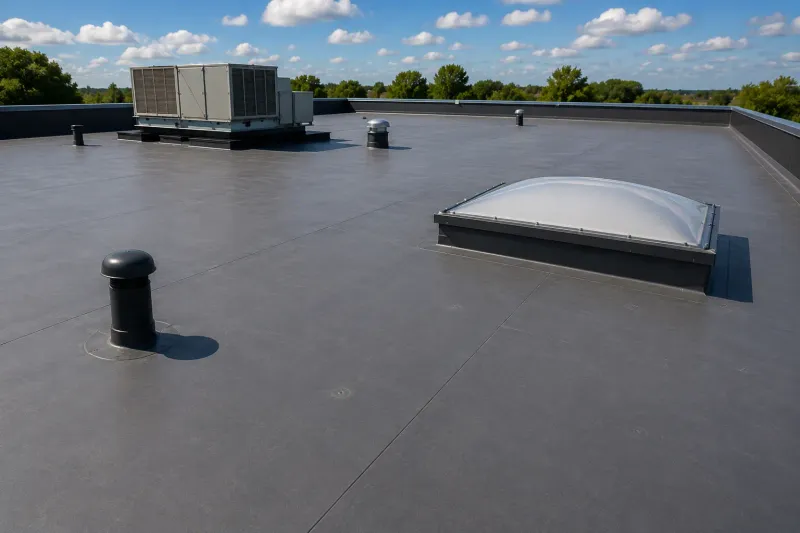
Yes. Metal roofing is used on flat and low-pitched roofs regularly, and it performs well when correctly specified. The two systems most commonly used are standing seam metal panels and single-ply membrane. Understanding which one suits your project is the more useful question to answer.
What “flat roof” actually means in practice
Very few flat roofs are truly flat. Building regulations require a minimum fall of 1:80 (about 0.7 degrees) to drain water effectively. In practice, most flat roofs are designed with falls of 1:60 or steeper to allow for construction tolerances and long-term deflection.
Metal roofing handles these low pitches well. The systems are designed for it. The challenge is not the metal itself. It is making sure the falls are built correctly, that water reaches the outlets, and that the detailing at edges and upstands is watertight.
If the falls are inadequate or ponding water is a risk, that is a substrate and drainage problem to resolve before any roof covering goes on. No waterproofing system performs well over standing water indefinitely.
Standing seam metal on a flat or low-pitched roof
Standing seam is a fully supported metal panel system with concealed fixings and no exposed fasteners. On a flat or low-pitched roof, panels are oriented to run water toward the drainage points. The seams lock adjacent panels together continuously along their length, which makes the system highly resistant to water ingress.
The minimum pitch for standing seam varies by system and manufacturer. Most systems can be installed from around 1.5 to 3 degrees, though some require additional seam treatment at the lower end of that range. Below the system minimum, standing seam is not the right choice, and a good installer will tell you that clearly.
Zinc and aluminium are the most common metals used on flat and low-pitched roofs. Zinc is widely specified on residential extensions across London and the South East for its natural grey tone and long service life. Aluminium is lighter, available in a range of pre-finished colours, and often more cost-effective. Both metals expand and contract across their length as temperatures change. The concealed clip fixing system accommodates this movement without buckling the panels or opening the seams.
For a more detailed look at how standing seam works as a system, our standing seam guide covers the mechanics and performance in full.
Single-ply membrane on a flat roof
Single-ply membrane is not a metal system in the traditional sense, but it is regularly grouped with metal flat roofing because it occupies a similar part of the specification. TPO, PVC, and EPDM membranes can be installed at very low pitches, often below what standing seam systems will accept, and they are a legitimate, well-proven flat roof solution.
Single-ply is faster to install than standing seam and generally less expensive. It covers large areas efficiently and is well-suited to straightforward flat roof replacements where budget and programme are the main constraints.
The trade-off is lifespan. Most single-ply systems carry manufacturer warranties of 20 to 25 years. A well-installed roof on a correctly designed substrate will often last longer, but a future replacement should be planned for. Standing seam zinc or aluminium, by contrast, has no conventional replacement cycle on a flat or low-pitched roof.
Our comparison of single-ply versus metal flat roofing sets out the full picture if you are weighing the two options directly.
Pitch thresholds: what the numbers mean
Pitch affects which system is viable and how much additional detailing is needed. As a general guide:
- Single-ply membrane: suitable from around 1:80 (0.7 degrees), sometimes flatter with specialist systems
- Standing seam metal: typically from 1.5 to 3 degrees depending on the system; some manufacturers specify additional seam locking below 3 degrees
- Conventional pitched metal: standing seam in standard configuration from around 7 degrees upward
These thresholds are not universal. The specific system, the panel width, the seam type, and the exposure of the site all affect what is acceptable. Always check the technical guidance for the system being specified, not general rules of thumb.
Cost per m²: Metal standing seam vs single-ply
Upfront cost is one of the main factors when choosing between single-ply membrane and metal standing seam for a flat roof. On a flat or low-pitched roof, the installed cost includes the waterproofing layer, deck or substrate, insulation build-up, and detailing at edges and upstands.
As a general benchmark across London and the South East, installed prices per m² typically range as follows:
- Single-ply membrane: £133–£150 per m² installed
- Aluminium standing seam: £140–£150 per m² installed
- Steel standing seam: £150–£160 per m² installed
- Zinc standing seam: £160–£180 per m² installed
- Copper standing seam: £250–£280 per m² installed
Key cost factors on a flat roof
- Substrate and insulation build-up: A warm roof specification requires rigid insulation and vapour control layers above the structural deck. Using tapered insulation to create fall gradients adds material and design cost.
- Upstands and rooflight detailing: Edge details, parapet caps, internal gutters, and kerbs for flat-roof rooflights require hand-forming and skilled labor, which increases the overall cost on complex roofs.
- Roof area and access: Small extension roofs carry higher per-m² rates due to fixed setup, scaffolding, and detailing requirements compared to large open roof planes.
- Whole-life value: While single-ply membrane requires a lower initial investment, it typically carries a 20–25 year warranty cycle. Standing seam zinc or aluminium provides a 60–100 year service life with minimal maintenance, offering superior long-term value for permanent structures.
For a more granular breakdown of zinc material, finish, and labor costs, read our comprehensive zinc roof cost guide.
Key considerations for a metal flat roof
The system choice is only part of the picture. Several other factors determine how a metal flat roof performs over time.
Substrate and deck
Standing seam on a flat roof requires a fully supported deck, typically OSB or plywood, to give the panels consistent bearing and a stable fixing plane. The deck needs to be dry, flat, and correctly tied into the structure. Any movement or deflection in the deck after installation will show in the metal.
Warm roof insulation build-up
Most flat metal roofs today are built as warm roofs, with insulation sitting above the structural deck. This keeps the deck on the warm side of the insulation, reduces condensation risk, and avoids the need for ventilated voids. On a low-pitched roof with rooflights or internal gutters, a warm roof build-up is usually the more reliable approach.
Our warm roof vs cold roof guide explains the build-up differences and where each approach fits.
Drainage falls
Falls need to be designed into the structure, not made up by the roofing contractor at installation. On a flat roof, a difference of a few millimetres across a span can mean the difference between a roof that drains cleanly and one that ponds. If tapered insulation is being used to create falls, the scheme needs to be engineered before the substrate goes down.
Upstand and rooflight detailing
Where the roof meets a wall, parapet, or rooflight kerb, the detailing is critical. Upstands need to be high enough to keep water away from the junction (typically a minimum of 150 mm), and the connection between the metal and the adjacent element needs to be formed correctly. Rooflights on a flat metal roof require carefully formed kerbs, and the rooflight-to-metal junction is one of the more common points of failure on poorly detailed roofs.
Standing seam or single-ply: which is right for your project?
For most residential flat roofs, the decision comes down to three questions.
How long do you want the roof to last? If the building is a long-term asset and you want a roof that does not need replacing within your ownership, standing seam metal is the stronger choice. If a 25-year roof is acceptable and budget is tight, single-ply is a sound option, not a compromise.
Is the roof visible? On a rear extension seen from the garden, appearance may be secondary. On a roof that is architecturally prominent or part of a design-led project, metal standing seam delivers a quality that single-ply cannot match.
What is the pitch? If the roof is genuinely very low, below the minimum for the standing seam system you are considering, single-ply is likely the more appropriate choice. Get the pitch confirmed on site, not just from drawings.
Get advice on your flat roof project
We install both standing seam metal and single-ply membrane on flat and low-pitched roofs across London and the South East. If you’re not sure which system fits your project, get in touch. We’ll give you a straight answer based on the specific roof, not a preference for one system over another.
You can also explore single-ply membrane and zinc roofing in more detail.